This book is a walk across Sicily, from Marsala on the west coast to Palermo on the north. A travel book then. But our route follows the march of Garibaldi and his thousand volunteers in 1860 in their attempt to support an ongoing Sicilian revolution and overthrow the Bourbon monarchy that governed the island. We walked at the same time of year they did, in the scirocco season, with the heat pushing forty degrees, taking the same paths they did, stopping in the same places. So it’s also a history book.
A curious thing about the story of Garibaldi and the Thousand is that while one knows that in the end they won – after all, so many of Italy’s city streets are named after them – nevertheless at every twist and turn it seems impossible to understand exactly how this could have happened, so large and well equipped was the army they were facing. The incongruity of the whole campaign feeds the many conspiracy theories and accusations of betrayal that are still voiced today.
What I tried to do in Across Sicily was to merge the experience of the walk, through Salemi, Calatafimi, Alcamo and Partinico, then across the mountains into the Golden Bowl around Palermo, with a chorus of the voices of all those involved at the time, bringing together the many diaries of the vollunteers, the communications between the Bourbon generals and their king, the accounts of Bourbon soldiers and officials, and the journals of citizens in Palermo during the three-day long Bourbon bombardment of the city that saw whole districts reduced to rubble and thousands of civilian killed.
Inevitably the book becomes a meditation on the relation between past and present, the Italy that the Risorgimento volunteers dreamed of and the Italy we have today. In the end, the past lives and instructs only in so far as we open ourselves to it accepting all the facts and putting aside our preferences and prejudices. This is what I tried to do in Across Sicily. All I can say is that the story that emerges, when you look at all the contemporary accounts, is beyond extraordinary.
Before Sicily – Quarto, 5 May, 1860
Before setting out on our walk, Eleonora and I visited Quarto where the Thousand embarked at night on small boats to row out to the paddle steamers that would take them to Sicily
-

- The rocky coast of Quarto dei Mille, now heavily built up
-

- The rock, or one of the many rocks, from which they embarked
-
- The first of many weather beaten plaques that will accompany us on our journey
Marsala, 11 May
“Entry in Marsala. Terrified look of the town.” Ippolito Nievo, 12 May.
-
- “There lies Marsala, with its walls, its white houses and green gardens, its pretty slope down to the sea.” Ceseare Abba in 1860. Alas, no longer…
-
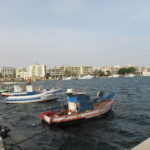
- While the Piemonte slipped easily into Marsala’s small harbour and anchored close by the wharf, the heavier Lombardo ran aground just outside
-

- “At 1.15 p.m. we arrive in Marsala. At 2.15 the landing was completed in perfect order.” Francesco Crispi.
-

- “Lifting my eyes, the arch of the gate seemed the entrance to an Arab city. Yet at the same time it felt like the gate of my own village, which also has an arch like this.” Cesare Abba
-

- MARSALA, MINDFUL AND PROUD, IN ETERNAL MEMORY OF THE PLACE WHERE THE THOUSAND AND THEIR LEADER GARIBALDI DISEMBARKED. IN ANTICIPATION OF A MORE WORTHY MONUMENT. 11TH MAY 1893
-

- AT DAWN OF 12TH MAY 1860 GASPARE COLICCHIA A HUMBLE COTTON WORKER LEFT WIFE AND DAUGHTER IN THIS HOUSE TO FOLLOW GIUSEPPE GARIBALDI’S THOUSAND AND DIE A HERO FOR A FREE AND JUST ITALY AT CALATAFIMI 15TH MAY 1860
To Salemi, 12 May
The first town on their route would be Salemi, an ancient
hilltop borgo, easily defendable, twenty-six miles from Marsala.
-

- “Solitude and vastness. True country of Theocritus.” Ippolito Nievo
-
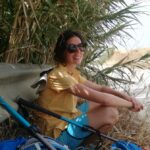
- “Every time we stopped the men crouched under hedges and bushes along the road, or wandered here and there looking for water.” Giuseppe Bandi
-

- “The only question people would ask from time to time was: how many miles have we walked?” Giuseppe Capuzzi
Salemi, 13-14 May
“They perched it up here, one house on top of another, and the whole pile ready to come tumbling down any moment.” Cesare Abba, 13 May, 1860.
-
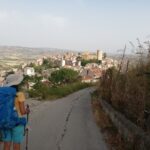
- “A real Saracen town, or rat’s nest, rather.” Ippolito Nievo
-

- Salemi is a snakes-and-ladders labyrinth of alleys and stairways built vertiginously upward towards a castle and cathedral at the top
-

- GIUSEPPE GARIBALDI, COMMANDER IN CHIEF OF NATIONAL FORCES IN SICILY, ON THE INVITATION OF THE LEADING CITIZENS AND FOLLOWING THE DECISION OF THE FREE TOWNS OF THE ISLAND, CONSIDERING THAT IN TIME OF WAR IT IS ESSENTIAL THAT CIVIL POWER BE CONCENTRATED IN A SINGLE MAN, DECREES HIS ACCEPTANCE, IN THE NAME OF VICTOR EMMANUEL, OF THE DICTATORSHIP OF SICILY. SALEMI 14TH MAY 1860
Vita, on the road to Calatafimi, 6.30 a.m., 15 May
“Rounding a hill the Thousand came suddenly into
the bare and characterless streets of Vita.” Trevelyan.
-

- “Barren, rugged, scorched by the sun.” Abba
-
- “We entered Vita and the people crowded the streets – children, women with their heads covered in white shawls, greeting us and shouting hurrah!” Capuzzi
-

- “In Vita the people were neither friendly nor hostile, because we hardly saw any people at all.” Bandi
Pianto Romano, Battle of Calatafimi, 15 May
We climbed a narrow path between thick bushes in sweltering stillness,
the sun veiled behind hazy cloud. Then the foliage parted, and you could see Pianto Romano directly opposite.
-

- “From up here we could see the enemy camp and the formidable position they held. “Capuzzi
-
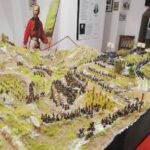
- “We rushed up Pianto hill clambering up the high terraces that formed the formidable enemy position.” Elia
-

- “Every time you climbed from one terrace to the next you had to expose yourself to tremendous gunfire.” Garibaldi.
-

- “In a space of twenty metres the dead and wounded lay huddled together. Blood soaked the contested soil.” Zasio
-

- “If, drawing my last breath, after all my battles, my friends see me smile, that will be for you, glorious fighters of Calatafimi.” Garibaldi
-
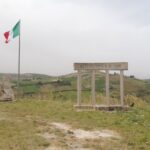
- “Here we make Italy or die.” Attributed to Garibaldi.
Calatafimi, after the battle, 16 May
““We climbed the road that leads to Calatafimi gazing in amazement at the castle with its strong defensive position, astonished that the Bourbons hadn’t chosen to hold it.” Capuzzi”
-

- The air hums with insects. To the left, a conical hill of inky pines and antique villas seems invented by a seventeenth-century landscape painter.
-
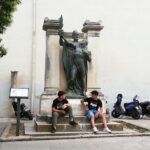
- “Arrival in Calatafimi. Medical assistance to the enemy wounded. Fanatical patriotism of the women.” Nievo
-
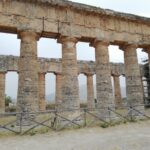
- “The emotions of the day after didn’t discourage those who had a strong feeling for places from walking to the ruins of Segesta. The ancient columns seemed strangely recent, and inspired a lofty melancholy.” Abba
To Alcamo, 17 May
“The road seemed longer than it was. We were so eager to arrive, so excited by the thought of being welcomed, as elsewhere, by a cheering crowd. All these acclamations had begun to tickle our vanity.” Capuzzi
-

- “Leaving Calatafimi at dawn, we were singing, then, when the sun came up to crush us, everyone fell silent, and we marched on like wraiths.” Abba
-
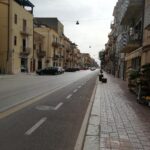
- “We marched into Alcamo at eleven. It’s a pretty town, albeit melancholy; in the shade of its streets you feel you’re moving into a Moorish atmosphere.” Abba. Evidently times have changed.
-

- “17th May. Excitement in Alcamo. The friar marching beside us blessed Garibaldi at the church door and ended with the cry, ‘Long live Garibaldi, long live Christ in the Blessed Sacrament.’” Nievo
To Partinico, 18 May
“18th May. March to Partinico, where the dogs are still
busy eating roasted Neapolitans. Not a mark of civilization.” Nievo
-
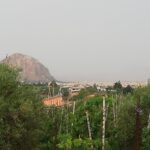
- To the south of the town, a reddish-brown rock face rises a thousand feet to loom over the cluttered housing.
-
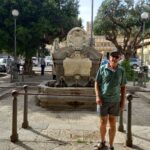
- In Piazza Duomo, where Corso dei Mille meets Via Vittorio Emanuele Orlando, there is an ornate eighteenth-century fountain where old men gather to fill bottles of water from eight elaborately carved waterspouts.
-
- “Pillage and blood avenged with blood… The peoples’ exhausted patience turns into rage …” Memories of 16 May, 1860
To the Renda pass. 18, 19 May
“These mountains are notorious for their grim tales of brigands. A person travelling alone was at risk of never being seen again.” Abba
-

- “The heat really bothered us that day. Fortunately, there was a brook with fresh water halfway up the valley.” Capuzzi
-

- “When we arrived, we were tired, dog-tired. The men threw themselves down where they stood, and for a while there was a deep silence.” Abba
-

- “We were at a loss to know how to eat the rice until the Sicilians showed us how to use paddles of prickly pear.” Capuzzi
-

- “Dear mother I assure you that this expedition is so poetic…” Enrico Cairoli
-

- Walking in this heat is a spiritual exercise.
-

- Nothing is more difficult than understanding the manoeuvres of armed men in a wild landscape like this
Descent to Pioppo, 20 May
Our route, climbing down from the heights towards the village of
Pioppo, took us along chalky tracks through dark pines clinging to
precipitous slopes.
-

- We are well below the pass now, tackling the last drop into the village of Pioppo. To our left are a range of forbidding rocky cliffs.
-

- We were funnelled down into a narrow street, steep as a water chute, all balconies and brightly laden washing lines, that eventually spills you out onto Pioppo’s main street.
-

- From Pioppo, nothing would be easier than to turn left along the flank of the mountain and walk four miles down to Monreale, then another five to Palermo.
Advance on Monreale. And Retreat. 21 May
-

- “A dawn so lovely you wanted to dissolve into the colours of the sky, the smells of the country.” Abba
-

- “In the morning our battalion advanced towards Monreale, while the Sicilians on the slopes above started to fire.” Capuzzi
-

- On the slopes above and below the road, the vegetation is dense. It’s beautiful, but it would be so easy to find yourself caught in an ambush.
-

- “We saw the smoke of gunfire, and our men retreating across the rocky slopes.” Abba
-

- Rosolino Pilo, who had sat down to write a dispatch to me on the heights of San Martino, was struck by enemy fire and fell down dead.” Garibaldi.
-
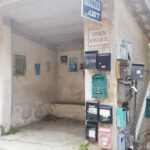
- The name of the locality is written with small black tiles on a background of white: “PENSABENE” – “Think Well”.
Into the Golden Bowl. Descent to Parco/Altofonte. 22, 23 May
I thus decided to cross, by night, from the road we were occupying to Parco, on the Palermo–Corleone road. Garibaldi
-
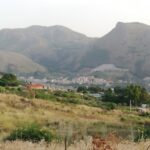
- “Returning to the Renda Pass, the men were settling down to rest. Instead the order came to break camp at once.” Crispi
-
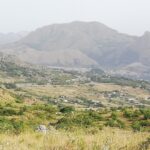
- “In haste, for an unknown destination.” Zasio
-

- “We took a precipitous path. At every step brambles, shrubs, plants in your way – streams full of water and rocks.” Capuzzi. Eleonora and I followed an easier trail.
Flight to Piana, 24 May
“The order came to climb further up the hill. But as soon as we were on the road, we were led towards the rising sun, away from the battle… it felt like we were fleeing from Parco, from Palermo.” Capuzzi
-
- “The order came to climb further up the hill. But as soon as we were on the road, we were led towards the rising sun, away from the battle… it felt like we were fleeing from Parco, from Palermo.” Capuzzi
-

- “Then as now the Bourbon army carried out annual exercises in these hills. They knew every path and vantage point.” Colonel Vagliasindi, 1911
-

- A portella is a little door, the name they give here to the mountain passes.
-
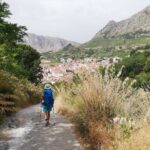
- “Panting, hungry, scorched by the sun” – Abba – “we relaxed a little at the sight of the town nestling in the valley.”
-

- It’s a charming hillside maze of well-swept, narrow stone streets with flowers and water fountains where swallows swoop back and forth from nests under balconies.
-

- We came across the monument, broken and derelict, to Pietro Piediscalzi, a native of this village who fought in Piana beside Rosolino Pilo when the Bourbons were repulsed here on 16th May 1860, only to die, as Pilo did, a few days later on 21st May in the battle above Monreale.
To Marineo, 24/25 May
“So we entered Piana dei Greci. And left again at 6 p.m.” Crispi.
-

- “25th May. At dawn we march towards Marineo.” Bixio
-
- “Our column followed Orsini, convinced that Palermo was no longer an option. The rumour was that Garibaldi would disband us and leave every man to himself. Time passed miserably, but after walking a while, and night had fallen now, we were led off the main road into a wood, where we slept.” Abba
-

- The road is a one-lane track, winding, rising, dipping between a thousand and two thousand feet, through an utterly parched landscape of white-gold grass, stained here and there with dark clumps of pine, a patch of dry bracken, occasional olive groves.
-
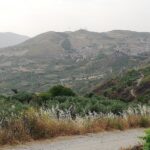
- “The path was hard work because of the endless ups and downs, but the views were so many and so beautiful the spirit was cheered and we had no time to feel tired.” Capuzzi
-
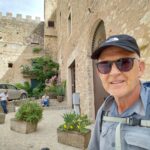
- “The crenellated Marineo,” Crispi
-

- “An exceedingly high rock, that looks like a wall, a work of art, not of nature. Completely isolated, it towers massively over the houses and palaces, with grasses and wild flowers clinging to its rugged crags and an ancient tree, right at the top, raisings its arms to the sky. It would be hard,” Capuzzi
To Misilmeri. 25/26 May
“I hope to be in Misilmeri tomorrow.” Garibaldi to La Masa, 25 May
-
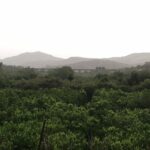
- “Out on the mountainside you could hear the goatherds calling, gathering their flocks.” Abba
-

- A strange wind stirred, gritty and warm. Hot air drifting across the hillside. Laden with dust, or sand.
-

- “Finally we emerged” – Abba – “from the frightening twists of the valley – and there in front and above us were a myriad of lights. Misilmeri, lit up to greet us.”
-
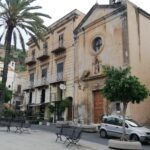
- Piazza Comitato 1860. “11 p.m. Misilmeri. To Signor General La Masa, wherever he may be. Dear La Masa, I hope to see you here at 3 a.m. to settle some important matters.
-

- IN THIS HOUSE UNDER THE CHAIRMANSHIP OF VINCENZO RUMBOLO IN MAY MDCCCLX THE CENTRAL COMMITTEE OF THE PROVISIONAL GOVERNMENT OF SICILY CREATED BY GIUSEPPE LA MASA HAVING SET UP CAMP IN GIBILROSSA DECIDED THE DESTINY OF THE SICILIAN REVOLUTION
-

- The town is tucked under the hillside, below the castle built in the early eleventh century by the Emir Jafar II. “MISILMERI, or MENZEL EL EMIR, Castello dell’Emiro.”
Gibilrossa, 26 May
“Bixio assigned a mule to every company to transport our food. Which suddenly made us think that we might be up in the mountains for some days.” Capuzzi
-

- “This position is excellent: a very high, extensive plateau betweenMisilmeri and Palermo.” La Masa
-

- IN THIS PLACE ON 26 MAY 1860 THE LEADER OF THE THOUSAND CAMPED HIS BRAVE MEN AND WAS WELCOMED WITH EXULTATION BY LA MASA AND THE PICCIOTTI
-
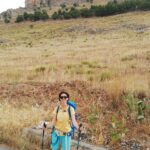
- “I hope we’re not going to stay here too long” – Abba – “or we’ll shrivel in the sun and go mad. It’s like having a cap of fire on your head.”
-

- The decision to attack is made in this monastery. Evening, 26 May. “Solemnity of the moment. General joy.” Nievo.
-

- Monument to the 1000. At the top of the descent.
-

- “We gazed at Palermo the way the Bedouin, after a long, tiring trek across burning desert sands, must gaze at the oasis he yearns to reach.” Capuzzi
Descent to Palermo, night of 26/27 May
“Having to follow a narrow, arduous path, our column of three thousand men stretched out in an endless line, and for the same reason it was impossible to ride back and forth to tighten the men up.” Garibaldi
-

- “It was barely a path at all dropping down from crag to crag. Abba
-

- “A precipitous path, where it was hard to stay on your feet.” Capuzzi
-
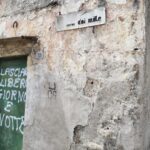
- “Down in the Palermo plain, La Masa managed to get lost and made us all take the wrong road.” Bixio
-

- “The road ran between dry stone walls and olive groves with occasional houses, dark and silent.” Abba. Times have changed.
-

- “The air began to freshen with the coming dawn. We were told to walk four by four and stay close to the orchard walls, then we quickened our pace.” Abba
-
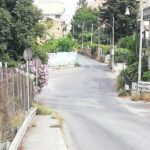
- “Approaching the city, our marching is more orderly and dawn is already breaking to bring a little reality to those fearful minds that darkness reduces to worse than sheep.” Bixio
Entry in Palermo, 27 May, dawn
“Advancing with bayonet and volleys of rifle fire almost at a run, putting to flight all the resistance we met… each man fighting in his own style.” Bixio
-

- “At the first light of dawn we found ourselves near Ponte dell’Ammiraglio, where the Bourbons attacked us and the battle began.” Vincenzo Fuxa
-
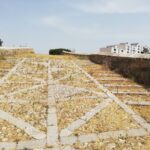
- “A wounded soldier was banging his head on the little wall of the bridge trying to smash his own skull, but Gerolamo Airenta gently pulled him away from it, then with his usual calm went on firing.” Abba
-
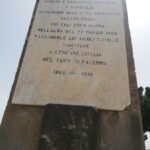
- SPIRIT AND EYE OF THE STRATEGIST GARIBALDI MADE THIS BRIDGE GLORIOUS AT DAWN ON 27TH MAY 1860 PASSING WITH THE SICILIANS AND THE THOUSAND VICTORIOUSLY ONWARD TO LOOK FOR ITALY IN THE HEART OF PALERMO 1860–1910
-

- “It was wonderful to see Garibaldi at moments like this. “He stopped his horse opposite the street that now bears his name, at the point where it crosses Via Lincoln. From the right the Neapolitan fleet was firing grapeshot, from the left the Bourbon infantry shot their bullets. Firm, imperturbable, he did not move until the last of his volunteers had entered the town.” Crispi
-

- BENEDETTO CAIROLI, SOLDIER OF LIBERTY, HERE CONSECRATED WITH HIS BLOOD THE GLORIOUS DAY OF REDEMPTION.
-
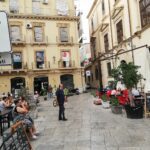
- “Is this really Piazza della Fieravecchia?” Abba “We barricaded the streets leading from the piazza with empty barrels and tables dragged from the surrounding shops.” Zasio
Palermo, 27 May
“My dear Adelaide, we entered Palermo this morning and accomplished the revolution.” The wounded Bixio to his wife
-
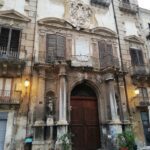
- “In Piazza Bologni seeing it was hard to keep together a strong core of men when spreading out through a big metropolis, I got off my horse and set myself up in a doorway.” Garibaldi
-

- “Furniture was thrown down from the windows, the paving stones torn from the streets, to build the barricades.” Capuzzi
-

- “A bomb falls on San Giuseppe dei Teatini “shattering the vault and going through the floor to explode in the Church of the Madonna della Provvidenza beneath, killing one of Professor Scandurra’s nieces.” Beninati
-
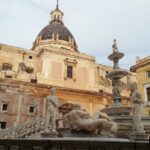
- “Part of the church of Santa Caterina has come down with a bomb.” Beninati. Santa Caterina
-

- “Christs and Madonnas and pictures of saints and everything precious was, terrible to say, destroyed. People expected a miracle – that didn’t happen.” Zasio
-

- “A number of families, victims of outrages and iniquities that cannot be written but can easily be imagined were finally released by Bourbon troops. They had not walked eighty paces when they were cut down from behind by rifle fire… They are still lying in the Piazza now. We don’t even know who they are.” Beninati.
Palermo, 28 May
“Perhaps nobody realized that this man… had come to bring down upon their city, and himself, and his men, utter carnage.” Abba
-

- “General Lanza’s cannons were raking the length of the Toledo from the Royal Palace.” Abba
-
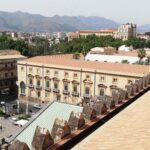
- “At two in the afternoon the insurgents occupy the bell tower of the mother church, whence they can fire down with advantage, causing many deaths among the soldiers and artillerymen of the Royal Palace.” Chronicle of Events
-
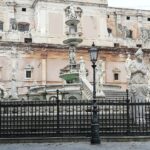
- “Garibaldi had them put a mattress on the steps of the fountain, opposite the big door of the Palazzo, and there, at the foot of one of the tall statues that grace the piazza, he was brought news, gave orders, rested.” Abba
Palermo, 29 May
“The bombardment is very violent this morning,” Beninati.
-

- From her aunt’s house by the port, the eighteen year old Giulia Beaumont watched “Families crowding onto ships, endless carts full of furniture and packing cases, and the bombs fell like balls of fire in their thousands on the poor city.”
-

- “This morning in the piazza of the Chiesa del Carmine the crowd killed six policemen and were about to burn the corpses. But a woman began to yell like crazy that Baby Jesus, in the arms of the Madonna over the door of the church, had turned his head away, not wanting to see such wickedness. Everyone was convinced they had seen the Baby’s head turn. A miracle.” Beninati
-

- “The bodies of the dead, assuming the many and strange shapes of death’s convulsions, lie unburied in the streets, where their nauseating smell poisons the air.” Borghese brothers
Palermo, 30 May. The armistice.
“God knows we needed a truce, obliged as we were to assemble cartridges that were fired as soon as made.” Garibaldi
-
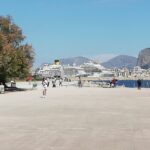
- The armistice was signed on board the British warship, HMS Hannibal anchored off the Palermo waterfront.
-

- “‘The enemy has offered conditions humiliating to the city of Palermo.’ Garibaldi pronounced these words from the first balcony of the town hall and concluded by asking the people if they wanted peace or war … ‘War! War!’ The people were delirious.” Beninati
-
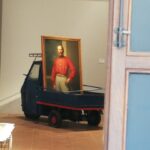
- “The idea was to enjoy the fruits of conquest, but to get rid of the conquerors.” Garibaldi on the attitude of the new regime after unification.